|
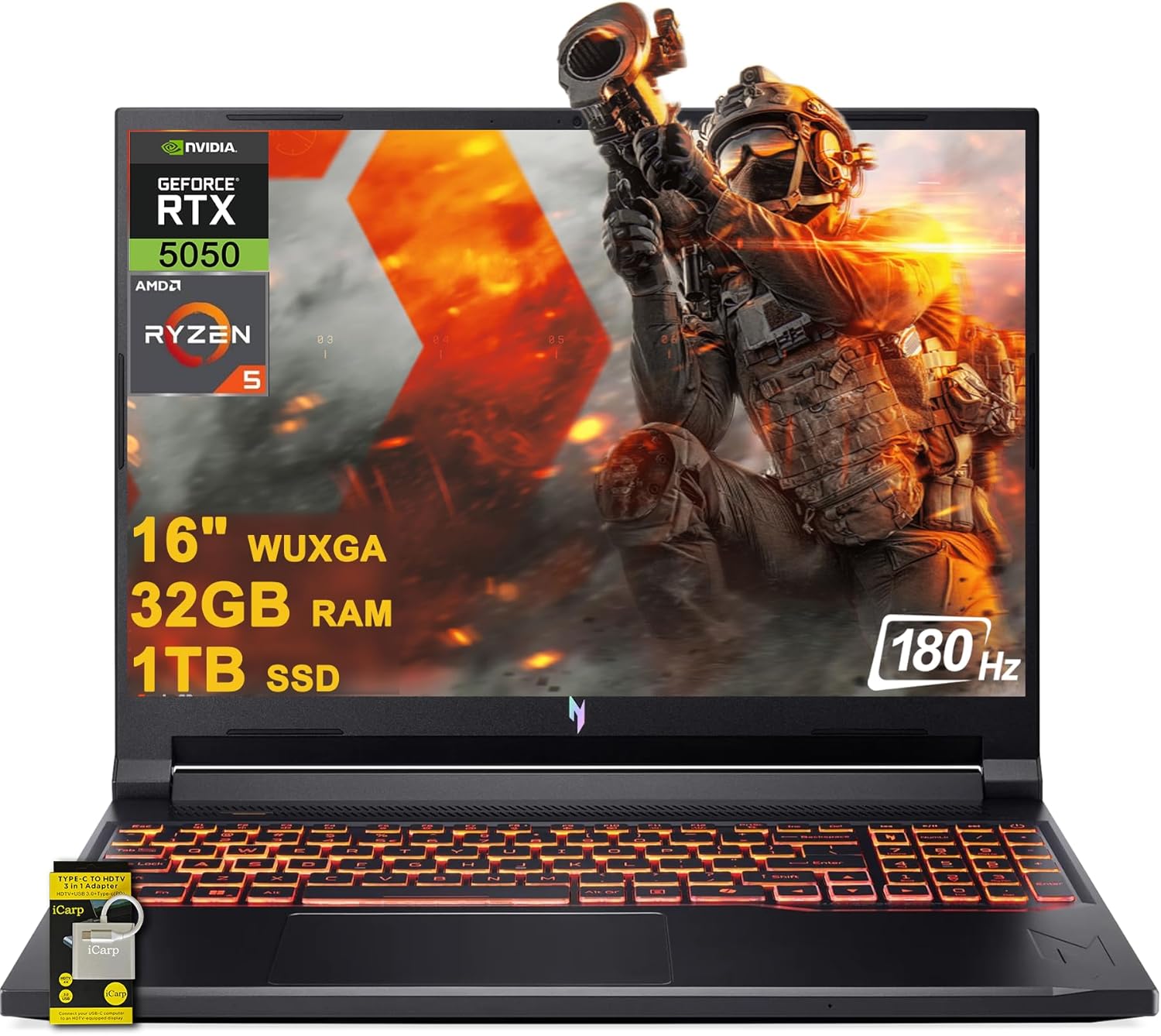
| Acer Nitro 18 AI gaming laptop |
Introduction: Entering the 18-Inch Arena
When it comes to gaming laptops, most of us are accustomed to the 15- to 17-inch range—portable enough to move around, yet large enough to deliver an immersive experience. But what happens when you push that boundary even further? Enter the Acer Nitro 18 AI, a massive 18-inch gaming behemoth that dares to ask: do you really need a desktop?
The 18-inch gaming laptop segment remains surprisingly niche, dominated primarily by Asus and MSI with their premium offerings. Now Acer enters the fray with their Nitro 18 AI, aiming to deliver maximum screen real estate at a more accessible price point. But does bigger automatically mean better? After extensive testing of the AN18-61-R10V configuration featuring AMD's new Ryzen AI 7 350 processor and NVIDIA's GeForce RTX 5070, we have answers.
Check current prices for the Acer Nitro 18 AI on Amazon
Design and Build Quality: Plastic Fantastic?
First Impressions
The Nitro 18 AI makes an immediate statement—this is not a laptop you casually toss into a backpack for your daily commute. With dimensions of 401 x 310 x 25mm and weighing 3.0 kg (6.6 lbs), it's firmly in desktop replacement territory. For context, that's lighter than some competitors (MSI's Vector A18 HX reaches 3.5 kg) but still substantial enough to remind you it's there.
Chassis Construction
Here's where Acer made some interesting choices. The chassis offers excellent stability throughout—no flex concerns when typing or during intense gaming sessions. However, if you're hoping for premium metal surfaces, you'll be disappointed. The Nitro 18 AI is entirely plastic-built, which at this price point feels like a compromise.
The design language walks a middle path—neither aggressively gamified nor professionally understated. Some angular elements on the underside add visual interest, but the overall aesthetic won't turn heads. The hinges perform reliably, offering a maximum opening angle of just under 150 degrees, which provides decent viewing flexibility.
Portability Considerations
Let's be realistic: you're not buying an 18-inch laptop for portability. The included 230W power brick adds another 734g, bringing total carrying weight to nearly 3.75 kg. This is a device that will live primarily on your desk, occasionally moving from room to room rather than coffee shop to coffee shop.
Display Analysis: Big Screen, Solid Performance
Specifications
The Nitro 18 AI features an 18-inch BOEhydis IPS panel with 2560 x 1600 resolution (16:10 aspect ratio) and a 165Hz refresh rate. These specs look good on paper, but how does it perform in practice?
Brightness and Contrast
With an average brightness of 288 cd/m², the display falls short of competitors that often exceed 500 cd/m². While this limitation rarely matters for indoor gaming, it does restrict usability in brightly lit rooms or near windows. The contrast ratio of approximately 1130:1 is respectable for IPS technology, delivering deep enough blacks for immersive gaming.
Color Performance
The display impresses with 99.9% sRGB and 97.2% DCI-P3 coverage, ensuring vibrant, accurate colors for both gaming and content consumption. However, out-of-the-box color accuracy leaves something to be desired with a Delta E of 5.16. Professional users will want to calibrate, while casual gamers probably won't notice the discrepancy.
Response Times
Gamers will appreciate the 9.4ms response time (black-to-white) and 6.8ms grey-to-grey. These figures place the Nitro 18 AI comfortably above average for gaming laptops, ensuring minimal ghosting during fast-paced action sequences.
Viewing Angles and Outdoor Use
Being IPS, viewing angles are excellent with minimal color shift. Outdoor use remains impractical regardless of viewing angles—the combination of moderate brightness and large size makes this strictly an indoor companion.
Ready to experience the massive display? Check availability here
Performance Testing: Ryzen AI 7 350 and RTX 5070 in Action
Processor Performance: The Ryzen AI 7 350
The AMD Ryzen AI 7 350 represents AMD's latest Krackan Point architecture, featuring 8 cores and 16 threads with a mix of Zen 5 and Zen 5c cores. With maximum boost clocks reaching 5.0 GHz and power limits configurable from 45W to 125W depending on mode, this processor aims to balance performance with efficiency.
Benchmark Results:
- Cinebench R23 Multi-Core: 18,243 points
- Cinebench R23 Single-Core: 1,963 points
- Geekbench 6 Multi-Core: 11,129 points
- Geekbench 6 Single-Core: 2,819 points
These numbers place the Ryzen AI 7 350 firmly in solid mid-range territory. It won't challenge flagship processors like the Ryzen 9 9955HX or Core Ultra 9 275HX found in premium competitors, but for gaming and everyday productivity, it delivers more than enough horsepower. The processor maintains consistent performance under load, with minimal throttling during extended sessions.
Graphics Performance: RTX 5070 Laptop
The NVIDIA GeForce RTX 5070 Laptop GPU comes with 8GB GDDR7 VRAM and a maximum TGP of 115W. This places it in the capable mid-range segment—sufficient for high-quality gaming at native resolution, though not always at maximum settings with ray tracing enabled.
3DMark Results:
- Time Spy Graphics: 13,753 points
- Fire Strike Graphics: 36,948 points
- Port Royal (Ray Tracing): 8,902 points
Gaming Performance Across Titles
We tested the Nitro 18 AI across several demanding titles at various settings:
| Game | Settings | FPS |
|---|---|---|
| Cyberpunk 2077 | 1080p Ultra (no upscaling) | 101 fps |
| Cyberpunk 2077 | QHD Ultra (no upscaling) | 51 fps |
| Call of Duty Black Ops 7 | QHD Extreme + RT (DLSS Balanced) | 45 fps |
| Call of Duty Black Ops 7 | QHD Extreme + RT + Frame Gen | 121 fps |
| Baldur's Gate 3 | 1080p Ultra | 115 fps |
| GTA V | 1080p Highest | 117 fps |
The RTX 5070 handles modern titles competently at 1080p and even QHD with reasonable settings. Ray tracing demands compromise, but DLSS and Frame Generation technologies bridge the gap effectively. In Black Ops 7, enabling DLSS Balanced increased performance from 24 to 45 fps at QHD Extreme settings, while quadruple frame generation pushed it to an impressive 121 fps.
Real-World Gaming Experience
During extended gaming sessions, the Nitro 18 AI maintains consistent frame rates without significant stuttering. The 165Hz display pairs well with the GPU's capabilities, though you'll rarely hit maximum refresh rates in demanding titles without upscaling assistance.
Operating Modes: Finding Your Balance
The NitroSense software provides four distinct operating modes that significantly impact both performance and noise levels:
| Mode | Cyberpunk FPS | Noise Level | GPU Power | CPU Power |
|---|---|---|---|---|
| Silent | 91.6 fps | 36 dB(A) | ~85W | 45W |
| Balanced | 97.1 fps | 42 dB(A) | ~95W | 65W |
| Performance | 101.3 fps | 54 dB(A) | ~105W | 75W |
| Turbo | 105.5 fps | 59 dB(A) | ~110W | 95W |
The real-world takeaway: Balanced mode offers the sweet spot, delivering nearly the same gaming performance as higher modes while keeping fan noise at comfortable levels (42 dB(A) is noticeable but not distracting). Performance and Turbo modes transform the laptop into a small aircraft during takeoff—effective but loud enough to require headphones.
Memory and Storage: Upgrade-Friendly Design
RAM Configuration
Our test unit came with 16GB DDR5-5600 RAM installed in one of two SO-DIMM slots, leaving one slot free for future upgrades. This dual-channel configuration performs adequately, though memory benchmarks reveal it lags behind competitors with faster implementations:
- AIDA64 Memory Read: 43,921 MB/s
- AIDA64 Memory Write: 42,576 MB/s
- AIDA64 Memory Copy: 37,823 MB/s
- Latency: 91.6 ns
Storage Performance
The 1TB Western Digital PC SN5000S NVMe SSD delivers solid but unspectacular performance:
- Sequential Read: up to 6,225 MB/s
- Sequential Write: up to 5,259 MB/s
- 4K Random Read: 62.6 MB/s
- 4K Random Write: 144.5 MB/s
Two M.2-2280 slots provide expansion flexibility, with one slot free for additional storage. The SSD maintains consistent performance during extended writes, though peak speeds don't match premium offerings from competitors.
Connectivity and Ports
Port Selection
The Nitro 18 AI offers respectable connectivity:
- 1x USB 2.0 (for legacy devices)
- 3x USB 3.1 Gen2 Type-A
- 1x USB4 40Gbps (with Power Delivery)
- 1x HDMI output
- RJ45 2.5G Ethernet (Killer E3100G)
- Audio combo jack (line-in/out)
- microSD card reader
- Kensington lock slot
Notably absent is Thunderbolt support, though USB4 provides similar functionality for most users.
Wireless Performance
The MediaTek RZ616 Wi-Fi 6E module delivers excellent real-world performance:
- iperf3 transmit: 633 MB/s
- iperf3 receive: 1,693 MB/s
While transmit speeds lag behind some competitors, receive performance is outstanding—ideal for game downloads and streaming.
SD Card Reader
The microSD card reader proves disappointingly slow at just 33 MB/s (copy test) and 36 MB/s (sequential read). Content creators frequently transferring photos or videos will find this frustratingly sluggish.
Webcam Quality
The Full HD webcam represents an upgrade over the typical 720p offerings found in many gaming laptops. Image quality remains merely acceptable rather than impressive—sufficient for video calls but not content creation.
Check current pricing and configurations on Amazon
Input Devices: Keyboard and Touchpad
Keyboard Experience
The RGB-backlit chiclet keyboard impresses with:
- Well-spaced layout with full-sized directional arrows
- Customizable RGB lighting for personalization
- Standard rubber dome feedback—not mechanical, but tactile enough
Key travel feels adequate, though enthusiasts might desire firmer feedback. The lighting customization through NitroSense provides ample options for matching your setup aesthetic.
Touchpad Performance
The generously sized touchpad measures approximately 15 x 9 cm (5.9 x 3.5 inches)—ample real estate for navigation. The surface offers smooth glide, though click feedback feels slightly vague compared to premium competitors. Most gamers will use an external mouse anyway, making this less critical.
Audio and Thermals
Speaker Quality
The 2.0 speaker system delivers adequate sound for casual use—clear enough for YouTube and voice chat, but lacking the bass and volume for immersive gaming without headphones. External speakers or a quality headset remain recommended for the best experience.
Thermal Management
Under load, the Nitro 18 AI maintains reasonable temperatures. The chassis design allows adequate airflow, though the fan noise trade-off is evident. In Balanced mode, thermals stay in check while noise remains manageable. Performance and Turbo modes push temperatures lower at the cost of significantly increased fan volume.
Battery Life: Surprisingly Capable
The 90 Wh battery represents a highlight, delivering better endurance than many gaming laptops:
- Mixed use (web, video, productivity): 5-6 hours
- Gaming (unplugged): Approximately 1.5-2 hours
- Video playback: 6-7 hours
These figures make the Nitro 18 AI usable for short periods away from an outlet—impressive for such a large, powerful machine.
Maintenance and Upgradability
Accessing internal components requires removing 10 Phillips screws, after which the bottom panel lifts away to reveal:
- Two SO-DIMM RAM slots (one occupied)
- Two M.2-2280 SSD slots (one occupied)
- Cooling solution with multiple heat pipes
- Battery and other components
This upgrade-friendly design extends the laptop's useful life—add more RAM or storage as your needs evolve.
Software and User Experience
Pre-installed Software
The NitroSense control center provides essential functionality:
- Performance mode selection
- Fan speed monitoring and control
- RGB lighting customization
- System monitoring
Windows 11 Home comes pre-installed with typical manufacturer bloatware—nothing excessive, but a clean installation might appeal to purists.
Latency Concerns
Our testing revealed high DPC latencies (9,845 μs in LatencyMon), which could affect real-time audio applications. Musicians and audio producers should exercise caution—this laptop prioritizes gaming over professional audio work.
Comparison with Competitors
Acer Nitro 18 AI vs. Asus ROG Strix G18 (2025)
The Asus offers superior CPU performance with the Ryzen 9 9955HX and brighter display (582 cd/m² vs. 288 cd/m²), but costs significantly more. The Acer provides better value for budget-conscious gamers.
Acer Nitro 18 AI vs. MSI Vector A18 HX
MSI's offering features more powerful GPU options (up to RTX 5070 Ti) and faster storage, but at a premium price point. The Acer wins on value but loses on peak performance.
Acer Nitro 18 AI vs. Asus TUF Gaming A18
The TUF A18 represents the closest competitor with similar specifications. Acer edges ahead with slightly better CPU performance and more upgrade options, while Asus offers a brighter display.
Pros and Cons
What We Love
- ✅ Excellent upgradability with two RAM and two SSD slots
- ✅ Solid gaming performance from RTX 5070
- ✅ Capable 90Wh battery for occasional portable use
- ✅ Customizable RGB keyboard with good layout
- ✅ USB4 connectivity for future-proofing
What Could Be Better
- ❌ Extremely loud in Performance and Turbo modes
- ❌ Disappointingly slow microSD card reader
- ❌ High DPC latencies affecting audio work
- ❌ Plastic build at this price point
- ❌ Moderate display brightness compared to competitors
Price and Availability
The tested Acer Nitro 18 AI AN18-61-R10V configuration (Ryzen AI 7 350, RTX 5070, 16GB RAM, 1TB SSD) is available from approximately €1,800 (~$2,092) through various online retailers.
Multiple configurations exist:
- Ryzen AI 5 340 with RTX 5050 (entry-level)
- Ryzen AI 7 350 with RTX 5070 (tested model)
- Ryzen AI 9 365 with RTX 5070 Ti (high-end)
View current prices and configurations on Amazon
Final Verdict: Is the Acer Nitro 18 AI Worth It?
The Acer Nitro 18 AI presents a compelling case for gamers seeking maximum screen real estate without paying flagship prices. It delivers solid 18-inch gaming performance with the capable RTX 5070, offers excellent upgradeability for future-proofing, and surprises with better-than-expected battery life.
The compromises are real but manageable: the plastic chassis feels less premium than competitors, the display brightness falls short of class leaders, and the fan noise in performance modes demands headphones. The slow card reader and high latencies will only affect specific users.
For gamers who prioritize screen size and upgrade potential over portability and premium materials, the Nitro 18 AI represents excellent value in the 18-inch segment. It won't outperform the premium offerings from Asus and MSI, but it doesn't need to—it just needs to deliver a great gaming experience at a more accessible price point, and in that mission, it succeeds admirably.
The bottom line: If you want an 18-inch gaming laptop without breaking the bank, the Acer Nitro 18 AI deserves serious consideration.
Frequently Asked Questions
Is the Acer Nitro 18 AI good for gaming?
Yes, the RTX 5070 handles modern games well at 1080p and QHD resolutions. Most titles run smoothly at high settings.
How loud is the Acer Nitro 18 AI?
In Balanced mode, it's reasonably quiet at 42 dB(A). Performance and Turbo modes reach 54-59 dB(A), requiring headphones.
Can you upgrade the RAM and storage?
Absolutely—two SO-DIMM slots and two M.2-2280 slots provide excellent upgrade options.
What is the battery life like?
Expect 5-6 hours for mixed use and 1.5-2 hours for gaming—impressive for an 18-inch gaming laptop.
Does it have a good display?
The QHD+ 165Hz IPS panel offers excellent color coverage and response times, though brightness is moderate.
Is it portable?
At 3.0 kg plus power brick, it's a desktop replacement—not for daily commuting, but movable around the home.
*Review based on extensive testing of the Acer Nitro 18 AI AN18-61-R10V configuration. Prices and availability accurate as of March 2026.*
Click here to check the latest price on Amazon
 |
| Acer Nitro 18 AI gaming laptop |